"Around here, us living in our own homes is a waste of money economically speaking, because we'd get higher and best use if we moved off the island and rented our house for a lot more than we're willing to pay for it."
Kill Devil Hills Mayor Ben Sproul said that to the Outer Banks Voice in April 2023, during a public hearing on expanding accessory dwelling units into the town's residential zones. He wasn't complaining. He was explaining the math that every owner on this stretch of the beach already does in their head: a house rented by the week almost always outearns a house rented by the year, and a house rented by the year almost always outearns a house someone simply lives in.
Kill Devil Hills has revised its zoning code over the last four years, and buyers comparing prices across the northern beaches need to read past the square footage and list price. Some of the newest, most attractively priced construction in town was built under rules that restrict it from the short-term rental pool. The house can look identical to the one two lots over. Only one may be eligible to earn weekly income under the current rules.
The block behind Walgreens and Starbucks
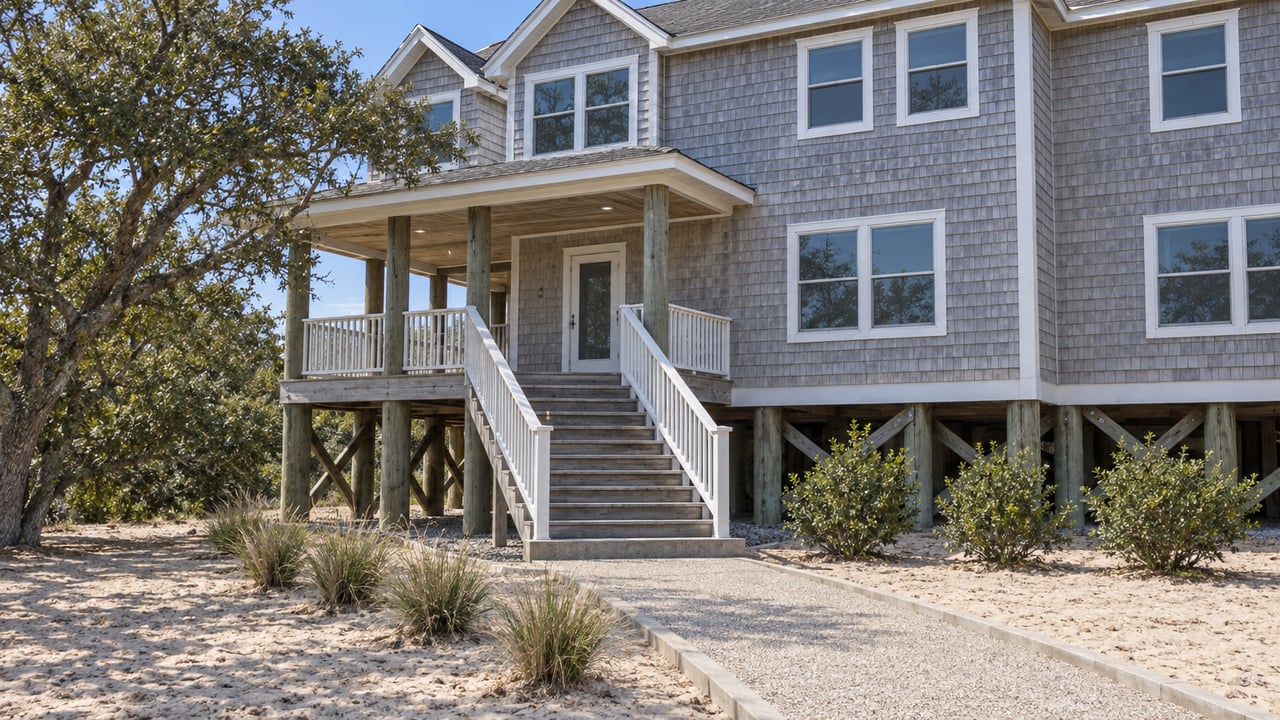
The clearest example sits on West Martin Street, on just under two acres behind the Walgreens and the Starbucks near milepost 9. In June 2023, Kill Devil Hills commissioners approved a site plan from developer Eddie Goodrich of The Woods at Kitty Hawk LLC for 21 homes on the parcel: ten three-bedroom units at 1,388 square feet and eleven two-bedroom units at 1,297 square feet, according to the Coastland Times. Town code defines long-term occupancy as a single tenant staying at least 31 days.
As Outer Banks Coast Life reported, Sproul was direct about the intent. "This opportunity to build in this style is intentional," he said at the hearing. "It's our goal as a board to find ways to create an incentive to have a deed restriction like this." He called the project the product of "a creative incentive structure," one meant to produce smaller homes he said had been "hardly ever seen in local new construction going back decades."
Not everyone at the hearing was convinced it would work as intended. As the Coastland Times reported, a neighbor named Matt Walker asked the question that still matters for anyone shopping this segment of the market today: "What if it doesn't work? If it is just more expensive houses packed together for people who can't afford them, it's not solving the intended problem." The commissioners approved the project anyway.
How Kill Devil Hills classifies smaller homes
Kill Devil Hills' zoning code treats three small-footprint housing types differently, and the differences matter enormously to anyone running rental numbers.
Cottage courts, permitted since the town's original ordinances in the late 2010s, are one of the types the town treats differently. Cluster homes, which the town adopted as its own special use category starting in 2022 and expanded that same year, are another type. Under the town's current ADU ordinance, an ADU in a low or high density residential district can only be used for long-term occupancy, and before a building permit is issued the owner must record a long-term use agreement with the Dare County Register of Deeds declaring the unit will be used that way "in perpetuity."
That word matters. Assistant Planning Director Cameron Ray told the Outer Banks Voice the agreement "will transfer with the property no matter who's the owner" and that "unless town ordinance changes, it can't change." The town also uses software to monitor short-term rental listings, and Ray said if a restricted ADU shows up booked on Airbnb, "that's going to alert your enforcement side of things" and the owner gets a violation.
For a buyer, none of this shows up in a standard listing description. It shows up in a title search, in the recorded agreement at the Register of Deeds, and in a conversation with the town's planning department about which zoning category a specific address falls under. Before writing an offer on new or newer construction in Kill Devil Hills, it's worth confirming a few things directly:
- Whether the property is classified as a cottage court, a cluster home, or a standard single-family lot
- Whether a long-term use agreement is recorded against the deed at the Dare County Register of Deeds
- Whether an HOA or COA governing the property adds its own rental restrictions on top of, or separate from, the town's zoning rules
- Whether the unit is an ADU, and if so, whether it was permitted before or after the 2023 expansion into residential zones
The math the town is trying to interrupt
The gap between short-term and long-term income in Kill Devil Hills is not subtle. As of August 2026, AirDNA reported 995 active short-term rental listings in town, with the average listing earning $57,300 in trailing twelve-month revenue at 58 percent occupancy and a $398 average daily rate. Revenue per listing was up 45 percent year over year, even as AirDNA's own count of active listings fell 56.7 percent over the same period, a sign that the pool of homes actually earning short-term income may be both smaller and more concentrated than it was a year earlier.
Compare that to the long-term side. Dare County's 2026 fair market rent for a two-bedroom apartment, the benchmark used to calculate the county's housing wage, was about $1,430 a month, or roughly $17,160 a year, according to data reported by Island Free Press. That's the scale of the gap Sproul was describing when he called short-term returns "generally so much higher than long-term."
| Short-term rental (whole home) | Long-term rental (2BR benchmark) | |
|---|---|---|
| Typical annual income | ~$57,300 average revenue | ~$17,160 at county fair market rent |
| Occupancy | 58% of available nights | Year-round lease |
| Data source and period | AirDNA, trailing 12 months through August 2026 | Dare County housing wage report, 2026 |
The same report found that about 30 percent of Dare County households, roughly 4,977 of 16,445, are cost-burdened, spending more than 30 percent of income on housing. Renters carry more of that weight than owners, with 48 percent of renters reporting difficulty affording housing compared to 26 percent of homeowners. Those figures describe housing affordability in Dare County.
The dial keeps turning
The town has amended these rules over time. In April 2024, commissioners reduced the maximum square footage for cluster homes and cottage courts from 2,500 to 1,800 square feet and added height and setback requirements. As the Coastland Times reported, Commissioner T. Dillon Heikens called the 1,800 square foot limit "a fair compromise in the middle," and the amendment passed unanimously.
By September 2025, the town was back at it, with Planning Director Meredith Guns proposing to reduce the minimum lot size for duplexes from 20,000 to 15,000 square feet in certain districts and discussing whether ADUs should be capped at 800 square feet with mandatory septic compliance. Around the same meeting, commissioners approved a separate 14-home SAGA Realty and Construction project on North Virginia Dare Trail, each home capped at 2,500 square feet, a reminder that not every small-footprint approval in town carries the long-term restriction. Some do. Some don't. The only way to know is to check the specific parcel.
For anyone comparing Kill Devil Hills to Duck, Corolla, or Nags Head on price alone, that distinction is the whole story. A $500,000 new-construction home here might be exactly what it looks like: a legitimate short-term rental candidate at a lower entry price than the northern beaches. Or it might be a cluster home unit.
A few questions worth asking early
Does this restriction apply everywhere in town, or just certain developments? It applies to ADUs permitted in low and high density residential zones since April 2023. HOA or COA rules can still limit rental terms independently.
How would I actually confirm whether a listing carries the restriction? A title search will surface a recorded long-term use agreement if one exists. The town's planning department can also confirm whether a specific address was permitted as a cluster home, cottage court, or standard lot.
If I buy an ADU and it doesn't work as a long-term rental, can I convert it later? Based on how the town has described these agreements, no. Assistant Planning Director Cameron Ray has said the restriction transfers with the property regardless of who owns it, and stays in place unless the underlying town ordinance changes.
Kill Devil Hills is still writing this rule as it goes, which means the version that applies to a listing today may not be the version that applied two years ago, or the one that applies two years from now. If you're weighing a property here against something in Duck or Corolla and the numbers only make sense with weekly rental income attached, that's exactly the kind of detail worth confirming before you're under contract rather than after. Sarah Collier works this stretch of the Outer Banks closely enough to know which addresses carry which restrictions. Let's Connect before you write the offer, not after.
This article is general information, not legal, tax or financial advice. Consult a qualified professional about your situation.